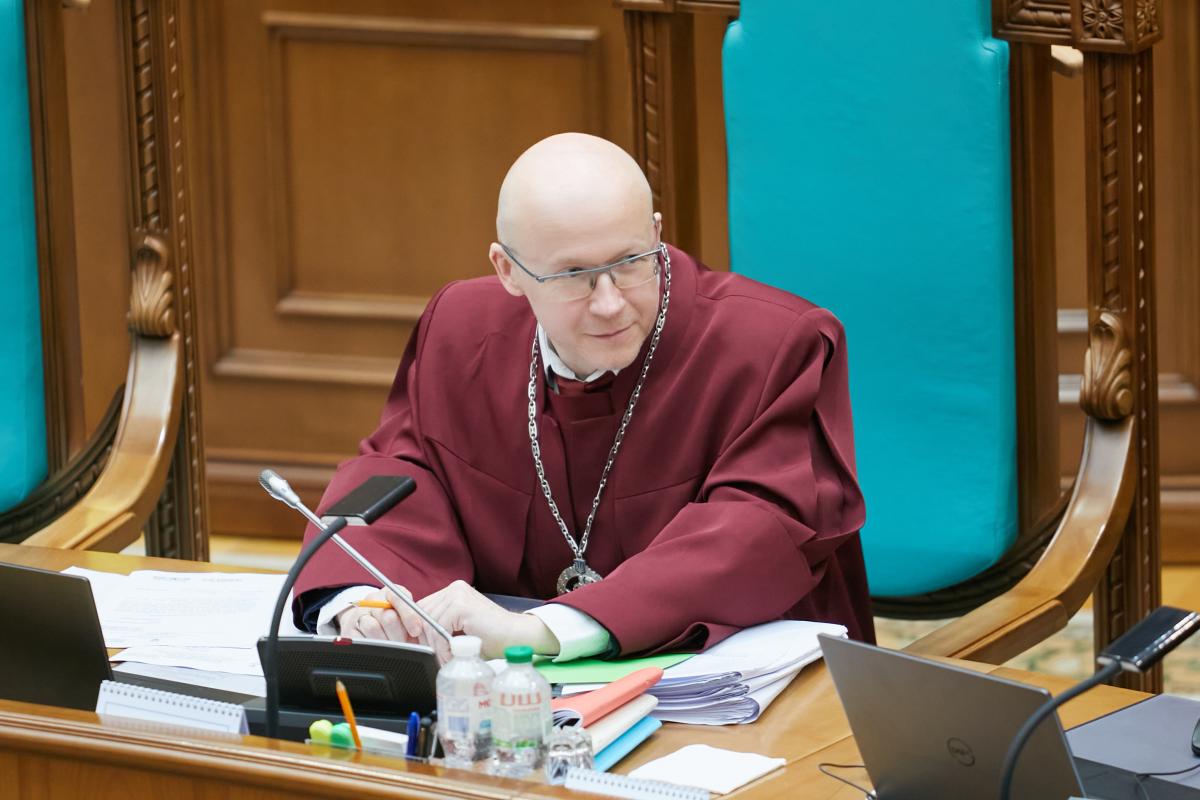
On 5 November 2026, the Grand Chamber of the Constitutional Court of Ukraine, at the public part of its plenary session held in the form of written proceedings, considered a case upon the constitutionality of Article 251.1.2 of the Civil Procedure Code of Ukraine (hereinafter, the “Code” or the “CivPC of Ukraine”), in so far as it establishes the court’s obligation to suspend proceedings “in cases on the recovery of child maintenance, an increase in its amount, payment of additional expenses for a child, recovery of a penalty (fine) for late payment of child maintenance, indexation of child maintenance, and a change in the method of its recovery”, pursuant to a constitutional petition of the Supreme Court.
During the plenary session, Oleksandr Vodiannikov, the Judge-Rapporteur in the case, informed the Court that, under the contested provision of the Code, a court is required to suspend proceedings in a case where “a party or a third party asserting independent claims in respect of the subject matter of the dispute is serving in the Armed Forces of Ukraine or other military formations established in accordance with the law and placed on a wartime footing or engaged in an anti-terrorist operation”.
In its constitutional petition, the Supreme Court argues that:
“the mandatory and imperative suspension of proceedings in cases on child maintenance pursuant to Article 251.1.2 of the CivPC of Ukraine restricts the essential content of the constitutional duty of parents to maintain their children and the constitutional right of a child to maintenance <…>.
The suspension of proceedings in child maintenance cases on the grounds that the defendant is serving in the Armed Forces of Ukraine for an indefinite period violates the principle of the rule of law and the requirement of the quality of law, as it creates a situation of prolonged legal uncertainty for the most vulnerable segment of the population, namely children, depriving them of the means of subsistence and effective judicial protection for an extended and unpredictable period of time <…>.
The application of an absolute and mandatory approach to the suspension of proceedings under Article 251.1.2 of the CivPC of Ukraine, without any judicial discretion and without taking into account the best interests of the child, is inconsistent with the Constitution of Ukraine, the UN Convention on the Rights of the Child and the case-law of the European Court of Human Rights. To ensure a balance between the rights and interests of the parties to the proceedings, procedural law should provide for a flexible mechanism enabling the court to assess the circumstances of each case and refuse to suspend proceedings where such suspension contradicts the best interests of the child”.
The Judge-Rapporteur informed the Court that, in order to ensure a comprehensive and objective consideration of the case, he had sent requests to bodies public authority and experts for information on the issues raised in the constitutional petition.
Having examined the case materials, the Court proceeded to the in-camera part of the plenary session.
The plenary session was attended by representatives of the subject of the right to constitutional petition, namely Rasim Babanly, Head of the Secretariat of the Supreme Court, Dmytro Hudyma and Vasyl Krat, judges of the Supreme Court, and Serhii Dembovskyi, Representative of the President of Ukraine in the Constitutional Court of Ukraine.
The video recording of the plenary session is available on the Court’s official website under “Video Broadcasts of the CCU’s Sessions” – “Archive of Video Broadcasts of Sessions”.