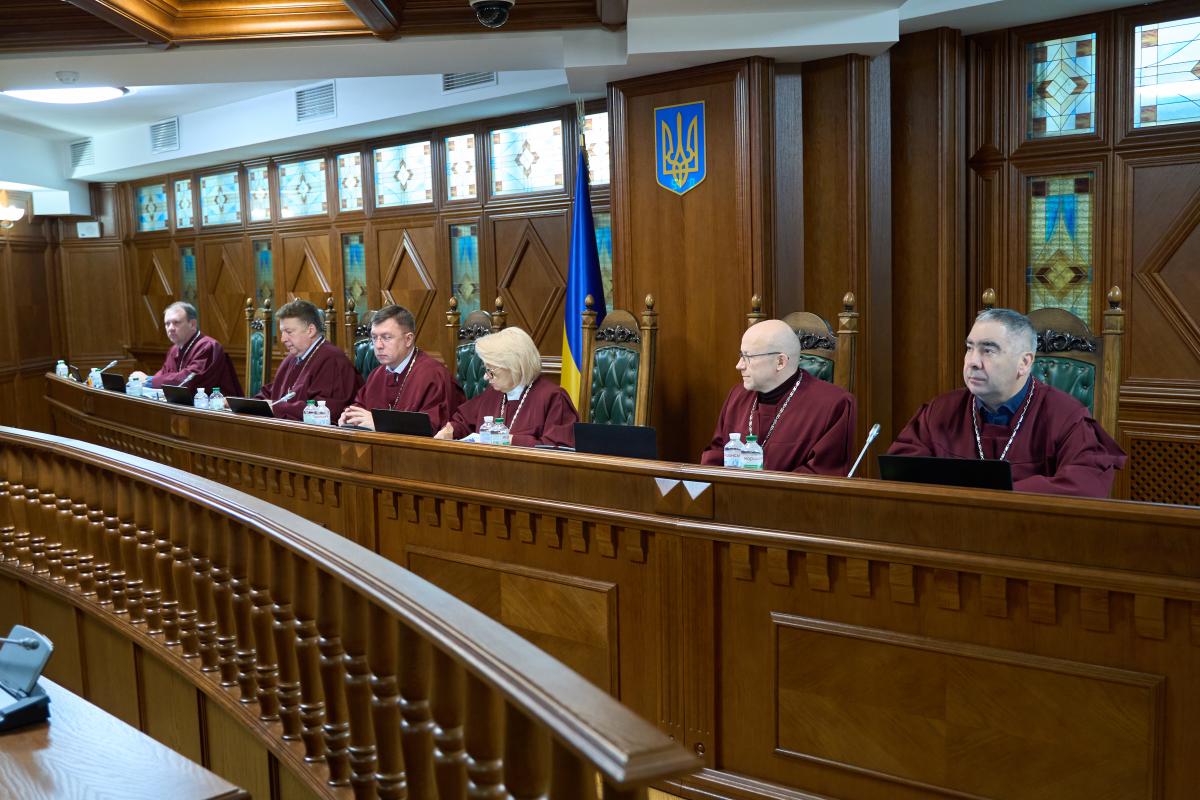
Actual Use of a Land Plot as Grounds for Recovering Funds and Denying a Tax Benefit: The CCU Examines the Case of LLC “ZHOVTEN”
22.10.2026
On 21 October 2026, the Second Senate of the Constitutional Court of Ukraine, during the public part of its plenary session, in the form of written proceedings, considered the case upon the constitutional complaint of Limited Liability Company “ZHOVTEN” (hereinafter, the “Company”).
During the plenary session, the Judge-Rapporteur in the case, Oleksandr Vodiannikov, outlined the substance of the constitutional complaint and the applicant’s arguments.
The judge reported that the Company, represented by its director, V. Vynohradenko, applied to the Constitutional Court of Ukraine seeking a review of the constitutionality of certain provisions of the Tax Code of Ukraine (hereinafter, the “Code”), namely:
· paragraph 52-4, specifically, “land plots owned or used, including under lease”;
· paragraph 69.14, specifically, “land plots […] owned or used, including under lease”;
· Subchapter 10 of Chapter XX “Transitional Provisions” of the Code, insofar as these provisions allow “a person who actually uses a land plot to be denied the right to exemption from the assessment and payment of land tax solely because the leasehold right has not been formalised and registered, where the fact of use of that land plot has been established by a court and that very fact has served as the basis for ordering that person to pay an amount equivalent to the land tax”.
The constitutional complaint, the documents and materials attached thereto indicate the following.
By a decision dated 4 July 2024, the Kyiv City Council leased two municipally owned land plots to the Company for a period of ten years for the operation of a shopping complex located on them, following the Company’s acquisition of ownership of that complex. In implementation of that decision, on 28 January 2025, the Kyiv City Council and the Company concluded a land lease agreement under which the Kyiv City Council leased the land plots specified in the agreement to the Company for the operation of the shopping complex.
According to the Main Department of the State Tax Service of Ukraine in Kyiv, before concluding the relevant lease agreement with the Kyiv City Council, the Company had paid its tax liabilities in respect of land tax and had paid more than UAH 12.8 million for the period from 12 March 2020 to 28 January 2025.
At the same time, according to the Kyiv City Council’s calculations, during that period the Company had underpaid by more than UAH 2.5 million for the use of municipally owned land plots. In April 2025, the Kyiv City Council filed a motion against the Company before the Commercial Court of Kyiv seeking to recover those funds.
The Commercial Court of Kyiv upheld the Kyiv City Council’s claim and ordered the Company to pay the Kyiv City Council more than UAH 2.5 million in funds unjustifiably retained, as well as court fees. The Northern Appeal Commercial Court upheld the first-instance court’s decision. The Commercial Cassation Court within the Supreme Court dismissed the Company’s cassation appeal and left the decisions of the first-instance and appellate courts unchanged.
The Company states that the “constitutional problem” lies in the fact that the same circumstance, the actual use of a land plot, was considered by the courts sufficient grounds for ordering the Company to pay an amount equivalent to the land tax, but insufficient grounds for granting it a tax benefit in respect of that tax. In the Company’s view, this results from the lack of clarity, internal inconsistency and “discriminatory normative content” of the contested provisions of the Code. Their application in the judicial decisions in its case resulted in the Company being burdened with a financial liability equivalent to the land tax for periods in respect of which the legislature had expressly provided for exemption from its assessment and payment.
The Judge-Rapporteur informed the Court that he had sent letters requesting information on relevant questions to public authorities and experts.
Having examined the case materials, the Court proceeded to the in-camera part of its plenary session.
The video recording of the plenary session is available on the Court’s official website under the heading “Archive of Video Broadcasts of Sessions”.