
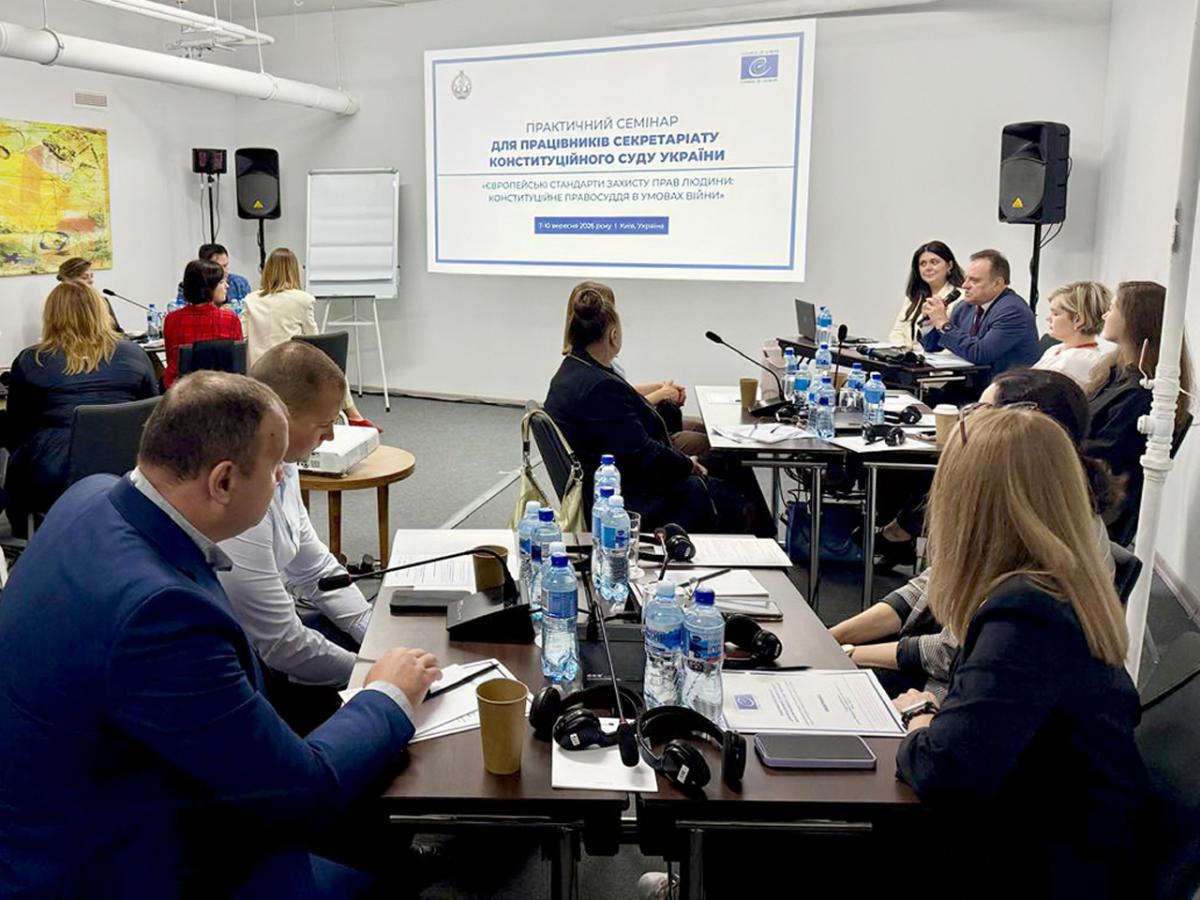
From 7 to 10 September 2026, a series of training events was held for the staff of the Secretariat of the Constitutional Court of Ukraine, focusing on the current issues related to the implementation of the European human rights standards in the field of constitutional justice.
The training sessions featured contributions from Olena Boryslavska, Head of the Constitutional Law Department at the Faculty of Law, Ivan Franko National University of Lviv and National Consultant to the Council of Europe; Kristaps Tamužs, Head of the Legal Department of the Constitutional Court of the Republic of Latvia and International Consultant to the Council of Europe; Lorena Bachmaier Winter, Professor at the Law Faculty of Complutense University Madrid and International Consultant to the Council of Europe; Alla Fedorova, Member of the European Committee of Social Rights, International and National Consultant to the Council of Europe; and Oleksandra Holub, Legal Expert of the European Equality Law Network and National Consultant to the Council of Europe.
The training events were opened by Viktor Beschastnyy, Head of the Secretariat of the Constitutional Court of Ukraine, and Siuzanna Mnatsakanian, Head of the Council of Europe Project “Further Support to the Constitutional Justice Reforms in Ukraine”. The format of the events included thematic presentations by experts, question-and-answer sessions, and discussions of practical aspects of the issues addressed.
As the part of professional discussions, participants considered the issue of striking a balance between national security requirements and the protection of fundamental rights under martial law, the importance of the case-law of the European Court of Human Rights and European legal standards for constitutional and legal reasoning, as well as specific aspects of protecting social and housing rights and the criteria for the admissibility and proportionality of restrictions on human rights.
A separate block was devoted to the opportunities and risks associated with the use of artificial intelligence (AI) technologies in constitutional justice. The discussion covered, in particular, the UNESCO’s Guidelines for the Use of AI Systems in Courts, the practical experience of the Constitutional Court of Republic of Latvia in introducing new technologies, the benefits and risks of using AI, as well as the limits of automating legal analysis. At the same time, it was emphasized that human involvement in the administration of justice remains an overriding priority.
Participants also discussed the role of legal language in upholding the principles of equality, non-discrimination and respect for human dignity. In this context, European approaches to inclusive and gender-neutral legal writing were consider, along with the risks of bias in judicial texts.
The series of training events contributed to strengthening the professional knowledge of the staff of the Court regarding contemporary European human rights standards, current challenges facing constitutional justice, and approaches that may be taken into account in their professional work.
The events were organized with the support of the Council of Europe’s project “Further Support to the Constitutional Justice Reforms in Ukraine”, implemented under the Council of Europe Action Plan for Ukraine “Resilience, Recovery and Reconstruction” 2023-2026.
Інформує відділ комунікацій КСУ та правового моніторингу
